
Chapter 7 Bankruptcy
Chapter 7 is a liquidation bankruptcy that discharges most unsecured debts — credit cards, medical bills, personal loans — without requiring any repayment plan. It is the fastest and most complete form of debt relief available under federal law, typically concluded within 4–6 months of filing.
- Discharges most unsecured debts: credit cards, medical bills, personal loans
- No repayment plan required — debts are wiped out at discharge
- Automatic stay stops garnishments, lawsuits, and collection calls immediately upon filing
- Garnishment funds taken within 60 days before filing may be recovered
- Means Test required — eligibility based on income relative to Washington State median
- Flat fee includes filing fee, credit counseling, and debtor education courses
- Bankruptcy-specific credit report pulled for $50 to begin evaluation
- Draft petition prepared for $450 (covers filing fee and required courses)
- Zoom consultation to review petition and advise on all options
- MetLife Legal Plans covers attorney fees
Starting with the worst-case scenario and working backwards through options is best practice. Nobody wants to file bankruptcy — it is the last resort after all options have been exhausted. Understanding whether you qualify for Chapter 7 puts you in the strongest possible negotiating position for debt settlement, if settlement is feasible.
Five Requirements to Qualify for Chapter 7
To qualify for Chapter 7 bankruptcy, you must meet all five of the following requirements: 1. Income — Your income must be below the Washington State median for your household size, or you must pass the Means Test. 2. Prior Discharge — You must not have received a Chapter 7 discharge in the past 8 years, or a Chapter 13 discharge in the past 6 years. 3. Non-Exempt Assets — You must not have non-exempt assets that you are unwilling to surrender to the Bankruptcy Trustee. 4. Tax Returns Filed — You must have filed all required tax returns for the past 4 years. 5. Current on Secured Debt — If you wish to keep your home and vehicles, you must be current on those payments at the time of filing.
The Means Test — Washington State Median Income (April 1, 2026)
Calculate your Current Monthly Income (CMI): average your gross income for the six full calendar months immediately preceding your filing date, then annualize by multiplying by 12. Household Size Annual Median Income ───────────────────────────────────────── 1 person $88,585 2 people $107,100 3 people $131,737 4 people $156,567 Each person over 4 add $11,100 If your annualized CMI is below the median for your household size, you pass the means test and are generally eligible for Chapter 7.
BATNA — Your Negotiating Leverage
BATNA stands for Best Alternative to a Negotiated Agreement. It is only your ability and willingness to file for bankruptcy protection that gives you any negotiating leverage with creditors. A creditor who knows you cannot or will not file bankruptcy has no reason to settle. A creditor who understands that you qualify for Chapter 7 and are prepared to file has every reason to negotiate. Always start with the worst-case scenario. Nobody wants to file bankruptcy — it is a last resort. But understanding whether you qualify, and what it would accomplish, is the foundation of every debt relief strategy.
Bankruptcy Exemptions — What You Get to Keep
Most bankruptcy filers keep everything they own. Approximately 99% of filers have no assets surrendered to the Trustee. Key Exemptions: • Wages — 75% of net wages are exempt from garnishment. • Homestead — approximately $729,600 in King County (Washington State exemption). • Retirement Accounts — IRAs and Roth IRAs are exempt up to $1,512,350. Do not borrow from or cash out retirement accounts to pay creditors. • Personal Property — generally more generous under the Federal exemptions; most Washington filers choose Federal. Debtors in Washington may choose either the Washington State exemptions or the Federal exemptions — but not a mix of both.
Property & Debt Classifications in Washington State
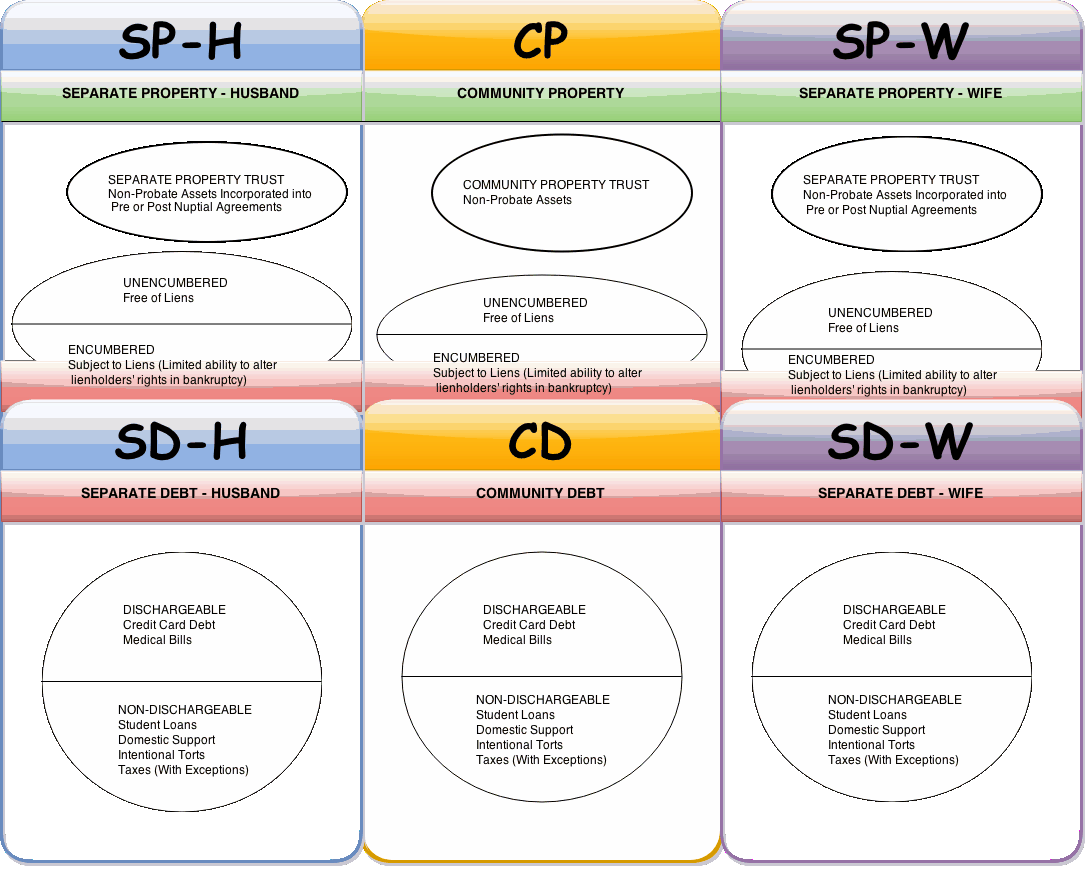
The chart below assists clients in visualizing the different ways property and debt may be held in Washington State. Property in Washington State may be held by the marital community or by each spouse separately, or a combination of the two. Dischargeable versus Non-Dischargeable: Knowing whether a debt may be discharged in bankruptcy is important in determining negotiating leverage and planning which debts to pay first. Always pay non-dischargeable debt first. Student loans are not dischargeable in bankruptcy — so paying credit card debt while not paying student loans when eligible for a Chapter 7 discharge makes no financial sense.
Garnishments — Act Quickly
If you have a garnishment, it will run for 60 days unless you file for bankruptcy. If you file, you will get back any funds taken from your paycheck within those 60 days — so it is important to file before the garnishment ends.
IRS Tax Liens — What Bankruptcy Cannot Fix
A Notice of Federal Tax Lien is one of the most serious financial events a taxpayer can face. Tax Liens Are Not Dischargeable in Bankruptcy — personal tax liability can be discharged only under very limited circumstances: all tax returns must have been filed on time, and all taxes must have been paid on time for three consecutive years (the 3-2-240 Rule). Even when personal liability is discharged, a tax lien that has already attached to property survives the bankruptcy. Payroll taxes withheld from employees — called trust fund taxes — are among the most dangerous debts a business owner can accumulate. They are almost never dischargeable, and the IRS has broad collection powers.
Credit Counseling Course — Required Before Filing
The 90-minute Online Credit Counseling Course is required before filing bankruptcy. The certificate is valid for 180 days. 1. Create an account at DebtorCC.org. 2. After creating your account, select Option 2. 3. Use attorney code mulvaney425cc to ensure the course fee is billed to Christopher and your certificate is sent to him automatically. After completing the course, you must call 1 (800) 610-3920 (press option 7) and speak with a counselor before your certificate will be issued.
Debtor Education Course — Required After Filing
The 120-minute Online Financial Management Course is required after filing, but before the 341 Meeting. 1. Create an account at DebtorCC.org. 2. Enter your Bankruptcy Case Number. 3. Use attorney code mulvaney425edu. 4. Enter Christopher's email — [email protected]. WARNING: If you do not obtain both certificates, your case will be dismissed without Discharge. It costs $500 to re-open your case.
Top 10 Pitfalls — What Not to Do Before Filing
1. Do Not Borrow from Retirement Accounts — retirement funds are exempt inside the account but not once withdrawn. 2. Stop Using Credit — cash advances within 70 days or credit within 90 days of filing are presumed non-dischargeable. 3. Stop Paying General Unsecured Creditors if your debt-to-income ratio is 35% or higher. 4. Do Not Pay Back Family Members — payments to insiders within one year before filing may be recovered by the Trustee. 5. Do Not Settle Debt Before Filing — you will owe income tax on the amount forgiven. 6. Do Not Bank Where You Have Credit — creditors can set off your account without notice. 7. Cancel All Automatic Payments and change banks. 8. Report All Assets — do not sell or transfer assets before filing. 9. Verify That the Creditor Has Perfected Their Lien on Your Car Before Filing (if purchased within 6 months). 10. Do Not Have an Unsecured Loan and a Secured Loan with the Same Creditor — cross-collateralization risk.
Reference Links
Schedule a Free Consultation
MetLife Legal Plans accepted. No-cost, no-obligation Zoom consultation with Christopher Mulvaney.