A fresh start — no payments required.
Chapter 7 is a liquidation bankruptcy that discharges most unsecured debts — credit cards, medical bills, personal loans — without requiring any repayment plan. It is the fastest and most complete form of debt relief available under federal law, typically concluded within 4–6 months of filing.
How Christopher Approaches Bankruptcy — What to Expect
Property & Debt Classifications in Washington State
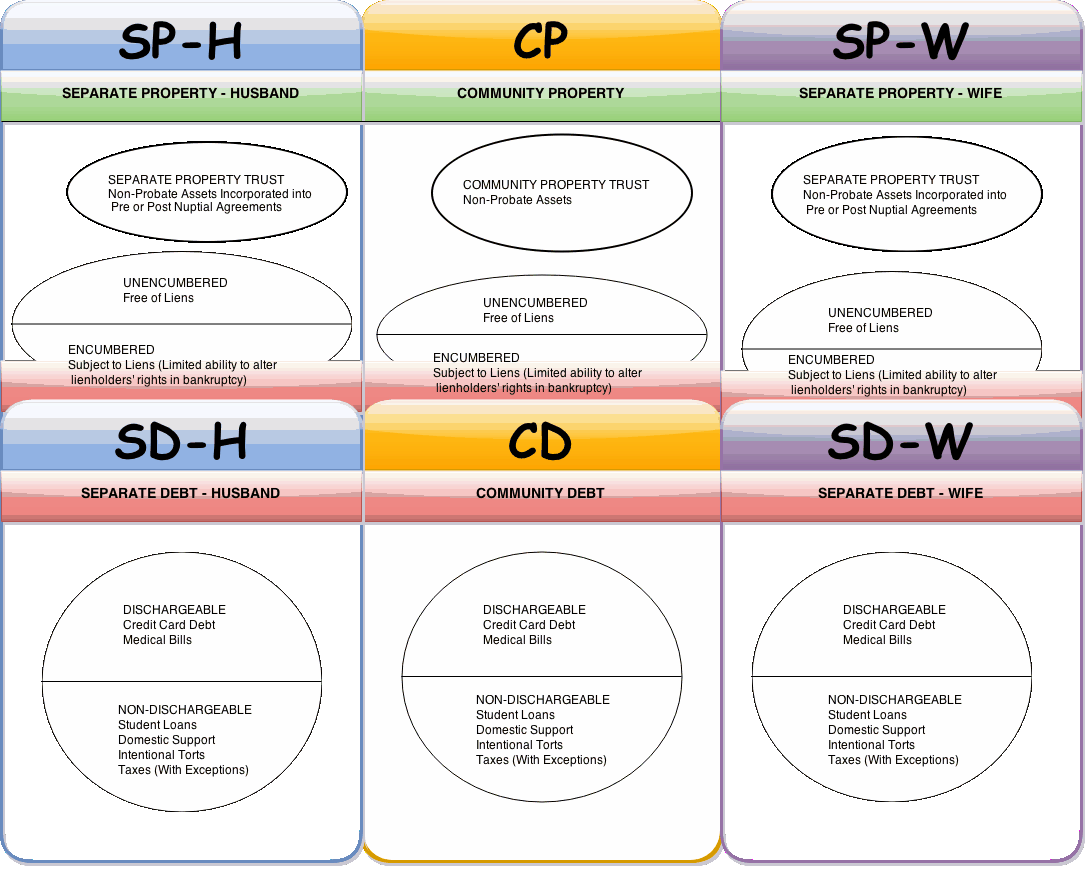
The chart below assists clients in visualizing the different ways property and debt may be held in Washington State, and what differences result based upon these distinctions.
Property in Washington State may be held by the marital community or by each spouse separately, or a combination of the two. Single people may hold property as joint tenants with right of survivorship or otherwise jointly own assets, but there is no presumption of community property that applies no matter how property is titled — as there is with community property.
In a Trust or Not in a Trust
Property may be held in a Community Property Revocable Living Trust or a Separate Property Revocable Living Trust. Doing so makes the property a non-probate asset, meaning that a Personal Representative does not need to be appointed by the Court to transfer the property — the Successor Trustee may do so. Holding property in a Separate Trust as a married person with a prenuptial or postnuptial agreement clearly identifies the property as separate and sets out the limits of contributions to separate property while married. The purpose of doing so is to rebut the presumption of community property clearly and in writing, to protect against the other spouse's claims as well as the separate creditors of the other spouse.
Burdened by a Lien or Not
Property itself has potential liability for debts either in addition to or instead of the potential personal liability of the individual(s) owning the property. This liability is referred to as a security interest — the right to repossess or foreclose for default on payments. Personal bankruptcy discharges personal liability, but does not affect liens except under limited circumstances in Chapter 13 (see Lien Stripping & Cram Down in this section). That is why a creditor may take back a car or boat, but may not sue you for the deficiency if you have obtained a bankruptcy discharge.
Dischargeable versus Non-Dischargeable
Knowing whether a debt may be discharged in bankruptcy is important in determining negotiating leverage and planning which debts to pay first. Always pay non-dischargeable debt first. For example, student loans are not dischargeable in bankruptcy. So, paying credit card debt while not paying student loans when eligible for a Chapter 7 discharge makes no financial sense.
Refiling & Waiting Periods — How Many Times Can You File?
There are no legal limits on the number of times you can file for bankruptcy. However, strict waiting periods are imposed before you can receive another discharge. These periods are calculated from the filing date of the previous case — not the discharge date.
Waiting Periods by Chapter Combination
• Chapter 7 after Chapter 7 — 8 years between filings.
• Chapter 7 after Chapter 13 — 6 years, unless you paid 100% of allowed unsecured claims in the prior Chapter 13, or paid at least 70% of allowed unsecured claims under a good-faith plan that represented your best effort.
• Chapter 13 after Chapter 7 — 4 years.
• Chapter 13 after Chapter 13 — 2 years.
Automatic Stay Without Discharge
You may technically file a new bankruptcy case before the waiting period expires. Doing so will trigger the automatic stay — temporarily halting collection actions — but you will not be eligible for a discharge. Courts scrutinize serial filings for potential abuse of the system.
Dismissal of a Prior Case
If a prior bankruptcy was dismissed due to your willful failure to appear or comply with court orders, or you voluntarily dismissed it after creditors sought to recover property, you may be barred from refiling for 180 days. If a case was dismissed with prejudice, you may be barred from refiling for a specific period — or potentially forever on the debts that existed at the time of the original filing.
A Real Example
Christopher had a client who filed Chapter 7 on her own but did not complete the credit counseling course. Her case was dismissed and she received no discharge. Five years later she came to him with thousands of dollars in medical bills that had accrued after her prior filing. Because she had never received a discharge and none of the other disqualifying conditions applied, she was eligible to refile and receive a full Chapter 7 discharge. She was fortunate — if she had previously received a discharge, she would have been required to file Chapter 13, which can be six times as expensive as Chapter 7.
Credit Counseling Requirement
Regardless of prior filings, completing a credit counseling course from an approved agency within 180 days before filing is required for both Chapter 7 and Chapter 13. This is separate from the Debtor Education Course required after filing.
Credit Counseling Course — Required Before Filing
The 90-minute Online Credit Counseling Course is required before filing bankruptcy. The certificate is valid for 180 days (6 months). If the certificate expires before you file, you must complete the course again.
This course is separate from the Debtor Education Course required after filing. Both certificates are required — missing either one will result in your case being dismissed without a Discharge.
Instructions
1. Create an account at DebtorCC.org to begin the Credit Counseling Course.
2. After creating your account, you will be presented with two options — select Option 2.
3. Use attorney code mulvaney425cc to ensure the course fee is billed to Christopher and that your certificate is sent to him automatically.
Important — Final Step to Receive Your Certificate
After completing the course, you will receive the following message:
"By law, to get your certificate you must call 1 (800) 610-3920 (press option 7) during the hours below and speak with a counselor. You will not get your certificate until you complete this step."
You must make that call and speak with a counselor before your certificate will be issued. Do not skip this step.
Support Hours
• Monday – Friday: 9 AM – Midnight EST
• Saturday – Sunday: 9 AM – 5 PM EST
Five Requirements to Qualify for Chapter 7
To qualify for Chapter 7 bankruptcy, you must meet all five of the following requirements:
1. Income — Your income must be below the Washington State median for your household size, or you must pass the Means Test (see below).
2. Prior Discharge — You must not have received a Chapter 7 discharge in the past 8 years, or a Chapter 13 discharge in the past 6 years.
3. Non-Exempt Assets — You must not have non-exempt assets that you are unwilling to surrender to the Bankruptcy Trustee. Washington State exemptions protect most of what the average person owns — but this must be analyzed carefully before filing.
4. Tax Returns Filed — You must have filed all required tax returns for the past 4 years.
5. Current on Secured Debt — If you wish to keep your home and vehicles, you must be current on those payments at the time of filing.
If you do not meet all five requirements, Chapter 13 may be the appropriate alternative. Christopher will analyze your specific situation before any petition is filed.
BATNA — Best Alternative to a Negotiated Agreement
BATNA stands for Best Alternative to a Negotiated Agreement — a concept from negotiation theory that is directly applicable to bankruptcy.
It is only your ability and willingness to file for bankruptcy protection that gives you any negotiating leverage with creditors. A creditor who knows you cannot or will not file bankruptcy has no reason to settle. A creditor who understands that you qualify for Chapter 7 and are prepared to file has every reason to negotiate.
By analyzing your worst-case scenario first — what you would need to do if you cannot reach a settlement — you accomplish two things:
1. You increase the chances of avoiding bankruptcy by negotiating from a position of informed strength.
2. You avoid making futile payments to creditors whose balances could be discharged, preserving those funds for necessities and filing costs.
Always start with the worst-case scenario. Nobody wants to file bankruptcy — it is a last resort. But understanding whether you qualify, and what it would accomplish, is the foundation of every debt relief strategy.
Debt-to-Income Analysis
Bankruptcy and debt settlement analysis requires your total unsecured debt divided by your gross annual family income — your debt-to-income ratio. A ratio of 35% or higher is considered high risk and is a strong indicator that bankruptcy protection may be appropriate. You can include more details about your situation on the intake form and attach any PDF documents you wish when you send it back.
The Means Test — Do You Qualify for Chapter 7?
The means test is the primary tool used to determine whether you qualify to file for Chapter 7 bankruptcy. It is an analysis to determine whether you have the financial "means" to repay your debts — thereby preventing abuse of the bankruptcy system by those who could afford to repay creditors through a Chapter 13 plan.
Step 1 — Compare Your Income to the Washington State Median
Calculate your Current Monthly Income (CMI): Average your gross income (before taxes) for the six full calendar months immediately preceding your bankruptcy filing date. Partial months are not counted.
Annualize your CMI by multiplying it by 12, then compare it to the Washington State median income for your household size.
Washington State Median Income Figures
(Chapter 7 cases filed on or after April 1, 2026)
Household Size Annual Median Income
─────────────────────────────────────────
1 person $88,585
2 people $107,100
3 people $131,737
4 people $156,567
Each person over 4 add $11,100
These figures are sourced from the U.S. Trustee Program of the Department of Justice and are updated approximately every May and November.
If your annualized CMI is below the median for your household size, you pass the means test and are generally eligible for Chapter 7. You do not need to complete Step 2.
Step 2 — Calculate Disposable Income (if your income exceeds the median)
If your income is above the state median, you proceed to Step 2. This involves deducting allowable monthly expenses using a combination of IRS standards and some of your actual expenses — including housing, utilities, food, transportation, and healthcare.
Subtracting allowable expenses from your CMI produces your monthly disposable income. If your disposable income is low enough to show you cannot make meaningful payments to creditors, you may still qualify for Chapter 7. If it is too high, you may be required to file Chapter 13 instead.
Important Exceptions
• Disabled veterans whose debts were incurred during active duty may be exempt from the means test.
• Debtors with primarily business-related debts may also be exempt.
• Even if you fail the initial calculations, you may argue that "special circumstances" justify additional expense deductions or adjustments to your CMI.
Consult Christopher before concluding you do not qualify. Bankruptcy law is complex, and the means test has nuances that can make the difference between Chapter 7 and Chapter 13.
IRS Tax Liens — What Bankruptcy Cannot Fix
"A man who is his own lawyer has a fool for a client."
— Early 19th-century proverb, Henry Kett, The Flowers of Wit (1814)
A Notice of Federal Tax Lien is one of the most serious financial events a taxpayer can face — and one of the most important reasons to consult an attorney before filing bankruptcy.
Tax Liens Are Not Dischargeable in Bankruptcy
Personal tax liability can be discharged in bankruptcy only under very limited circumstances: all tax returns must have been filed on time, and all taxes must have been paid on time for three consecutive years. Even when personal liability is discharged, a tax lien that has already attached to property survives the bankruptcy and remains a burden on that property.
A Real Example
Christopher had a client whose business was struggling. To keep the business afloat, he maxed out his credit cards and stopped remitting the federal income, Social Security, and Medicare taxes he was withholding from his employees' paychecks. The bankruptcy discharged his credit card debt — but the IRS tax lien for over $300,000 permanently remained on his house, accruing interest. It gutted any future proceeds from the sale of his home and deeply affected his retirement standard of living.
The lesson: payroll taxes withheld from employees — called trust fund taxes — are among the most dangerous debts a business owner can accumulate. They are almost never dischargeable, and the IRS has broad collection powers including liens, levies, and personal liability assessments against responsible parties.
If you have an IRS tax lien, consult Christopher before filing bankruptcy so you understand exactly what the discharge will and will not accomplish.
Garnishments — Act Quickly
If you have a garnishment, it will run for 60 days unless you file for bankruptcy. If you file, you will get back any funds taken from your paycheck within those 60 days — so it is important to file before the garnishment ends. If you do not file, you will have a settlement opportunity after 60 days. Christopher can assist with your bankruptcy evaluation and analysis, which is also needed to evaluate settlement feasibility.
Cease & Desist — Responding to Collection Letters
You can use a cease and desist letter to respond to any collection letters you receive. Scan and email the creditor's letter to Christopher, and mail the original letter back to the creditor. Doing so redirects communication away from you to his office and demands proof that you owe the debt. Many creditors will stop pursuing you based on the letter alone.
If you were served with a Summons & Complaint, complete and mail the attached Notice of Appearance to the Court and to Plaintiff's Counsel to avoid a Default Judgment — complete, sign, and send to Christopher for review before you mail it.
The combination of a letter from a lawyer every time you receive a collection letter, and a dispute every time inaccuracies are reported on your credit report, telegraphs to creditors that you are a responder. Creditors make money from default judgments against non-responders.
Getting Started — Credit Report & Petition Preparation
Pay $50 via Zelle, e-check, or Visa/Mastercard debit card (in that order of preference) and Christopher can download your bankruptcy-specific credit report. You can then enter information into the BK Packet website to assist with petition preparation — this gives you a sense of the information required. Only enter creditors you don't think will appear on your credit report. Anything you enter or upload is helpful. Don't stress about it — something is better than nothing. Everything will be reviewed together in a Zoom meeting.
If you want Christopher to prepare a draft of your petition for analysis, pay an additional $450 — this covers the bankruptcy filing fee and the required credit counseling and debtor education courses. If you file, you have already paid the costs of filing. If you don't file, that amount is the flat fee for preparation of the draft petition and advice about your options.
The more you do before the meeting, the more productive it will be — but anything you do is helpful. Christopher's goal is that you will feel less anxious and more in control as a result of your consultation.
Student Loans — Income-Based Repayment as an Alternative to Bankruptcy
Student loans are generally not dischargeable in bankruptcy. Before filing, it is worth exploring whether an income-based repayment program can reduce your monthly payment to an affordable amount — or even zero — and keep you out of default.
Income-Based Repayment (IBR)
IBR is a federal repayment plan that caps your monthly student loan payment based on your income and family size. If your income is low enough, your required payment can be set at $0 — keeping you current without any out-of-pocket cost. After 25 years of eligible payments, any remaining balance is forgiven.
Pay As You Earn (PAYE)
PAYE is a newer repayment plan with a lower monthly payment cap than IBR. It provides forgiveness after 20 years of payments rather than 25. Recent college graduates with federal loans taken out after October 2007 are generally eligible.
Public Service Loan Forgiveness (PSLF)
If you are a teacher, government employee, or work for a nonprofit 501(c)(3) organization, you may qualify for Public Service Loan Forgiveness after 10 years of eligible payments and employment. This can result in complete forgiveness of your remaining federal student loan balance — far sooner than the 20- or 25-year IBR/PAYE timelines.
Why This Matters in Bankruptcy
Because student loans survive bankruptcy discharge in almost all cases, reducing or eliminating the monthly payment through IBR or PAYE can remove student loans as a driver of financial distress — potentially making bankruptcy unnecessary, or making a Chapter 13 plan more feasible by reducing your required monthly obligations.
Use the Department of Education's Repayment Estimator at studentaid.gov to calculate what your payments would be under each plan.
After Filing — What Happens Next
Christopher has registered you for electronic notice by email of all documents filed in your case.
Zoom Section 341 Meeting of Creditors
The Section 341 Meeting of Creditors — the opportunity for the Bankruptcy Trustee to ask you questions, which you are required to answer under oath — is conducted via Zoom as the post-Covid standard. The Zoom link and phone number (if needed) will be on the Notice you receive by email and regular mail.
FBI Investigates Bankruptcy Crimes
Federal law provides severe criminal penalties for bankruptcy crimes, including bribery, concealment of assets, false statements, false claims, filing under a fictitious name, and perjury. Title 18, United States Code, Sections 152 and 3571 provide penalties of up to 5 years imprisonment, a fine of not more than $250,000, or both. The FBI investigates bankruptcy crimes.
Chapter 13 — Confirmation Hearing
If you filed under Chapter 13, you do not need to attend the confirmation hearing scheduled after your 341 Meeting. You will not receive a discharge until you complete the plan — which takes a maximum of 5 years.
National Data Center (Chapter 13)
The National Data Center maintains records for all Chapter 13 cases. Create a free account at ndc.org to track payments, claims, and disbursements in your case. Doing so is very helpful and will answer many of your questions.
Documents Required Before the 341 Meeting
You must email the following to Christopher at least 10 days before the Zoom 341 Meeting so he can upload them to the Trustee's website in time for review:
1. Driver's license
2. Social Security card (or W-2)
3. Last tax return filed
4. Pay stubs for 60 days including the filing date
5. Bank statements including the filing date
The Court only accepts PDF documents — please scan everything to PDF. Do not send paper documents, as they create delays. If documents are not received in time, your case will be continued and you will have to appear on Zoom again.
The Trustee will ask whether you read the Bankruptcy Information Sheet.
Debtor Education Course (Required After Filing)
The 120-minute Online Financial Management Course — also called the Debtor Education Course — is required after filing bankruptcy, but before the 341 Meeting.
Instructions
1. Click to create an account at DebtorCC.org to begin the financial management course.
2. You must enter your Bankruptcy Case Number to start the course — for example: 25-54321.
3. Use attorney code mulvaney425edu to ensure the course fee is billed to Christopher and that your certificate is sent to him automatically.
4. Enter Christopher's email address — [email protected] — to ensure your certificate is filed with the Court.
Technical Support
Contact DebtorCC.org at 1 (800) 610-3920 for any technical issues:
• Monday – Friday: 9 AM – Midnight EST
• Saturday & Sunday: 9 AM – 5 PM EST
WARNING: If you do not obtain both a Credit Counseling Certificate (required before filing) and a Debtor Education Certificate (required after filing), your case will be dismissed and closed without Discharge. It costs $500 to re-open your case to receive a Discharge.
Automatic Payments — Important
Automatic payments for secured debts such as houses and cars will stop when you file bankruptcy. You will need to make those payments manually during your bankruptcy and restart automatic payments after your Discharge.
"Chapter 20" — Filing Chapter 7 Followed by Chapter 13
"The power to tax involves the power to destroy... the power to destroy may defeat and render useless the power to create... beyond which no institution and no property can bear taxation."
— Chief Justice John Marshall
It is possible to file Chapter 7 first, followed by Chapter 13 in a sequence euphemistically referred to as "Chapter 20."
WARNING: This strategy is controversial and is disfavored by both Bankruptcy Trustees and Bankruptcy Judges. The risk of objection is significantly higher than in a standard filing. Do not pursue this strategy without careful consultation with Christopher.
When Chapter 20 May Apply
This strategy applies only to debtors who are eligible for Chapter 7 and who have an objective that cannot be accomplished in Chapter 7 alone.
Example: A below-median income debtor who owes the IRS and is behind on a car payment — but who expects a better job in two or three years — may choose to file Chapter 7 first to discharge unsecured debt, and then file Chapter 13 to pay off the IRS and the car. The advantage is that the Chapter 13 plan is calculated based on income at the time of the Chapter 7 filing, not the higher future income. Unsecured creditors receive less than they would have if the debtor had simply waited and filed Chapter 13 alone.
Why Trustees and Judges Disfavor It
It is the protection of future income — income that would not have been shielded if the debtor had filed Chapter 13 alone — that makes this strategy appear unfair from the creditors' perspective, particularly when increased earnings would have been sufficient to repay 100% of the debt.
Christopher's Standard Advice
Do not do anything you would be uncomfortable explaining in open court. Keep the perspective of creditors, Trustees, and Judges in mind when evaluating any bankruptcy strategy.
WARNING — Disclosure Obligation: If you reasonably expect a change in employment or income within one year of filing, that expectation must be disclosed. Any income that has been earned but not yet received — such as commissions — must also be disclosed.
Top 10 Pitfalls — What Not to Do Before Filing
YOU MUST READ AND UNDERSTAND THE BANKRUPTCY PETITION, AND NOTIFY CHRISTOPHER OF ANY ERRORS OR OMISSIONS, BEFORE YOU SIGN IT AND IT IS FILED. FAILURE TO DO SO IS AN UNCONSCIONABLE BREACH OF YOUR DUTIES AS A DEBTOR.
1. Do Not Borrow from Retirement Accounts
Retirement funds are exempt when held inside the retirement account — but are not exempt once withdrawn. If you borrow $50,000 from your 401(k) and deposit it into your checking account before filing, you will lose the $50,000 to creditors and still owe the 401(k) loan. This is especially important in Snohomish County, where adverse outcomes are more likely than in King or Pierce County.
2. Stop Using Credit (Including Payday Loans and Cash Advances)
The Bankruptcy Code presumes you did not intend to repay if you take a cash advance within 70 days of filing, or use credit within 90 days of filing — and you will be required to repay that amount. Even credit used more than 90 days before filing can be challenged if a creditor can show you lacked the intent to repay. Do not charge when you lack the income to repay, and do not charge and then stop making payments. All credit access will be terminated upon filing — prepare now for how you will live without credit.
3. Stop Paying General Unsecured Creditors if Your Debt-to-Income Ratio is 35% or Higher
Unsecured creditors have no collateral to repossess. If you pay any unsecured creditor more than $600 in the 90 days before filing, you may be required to pay that amount back so all unsecured creditors can share on a pro-rata basis — this is called a preference. Continue paying taxes, child support, spousal support, and student loans, as these are not in the same class as general unsecured creditors. Preferential payments may require conversion to Chapter 13 if the amount cannot be repaid in a lump sum. If you want to keep secured collateral (car, appliances), keep paying the secured creditor.
4. Do Not Pay Back Family Members Before Filing
Spouses, parents, siblings, cousins, and adult children are "insiders" under the Bankruptcy Code. Payments to insiders made within one year before filing may be recovered by the Trustee — typically by requiring the debtor to convert to Chapter 13 and waive the statute of limitations on the Trustee suing the relative who received the money. Pay family members after your discharge.
5. Do Not Settle Debt Before Filing
If you settle a debt before filing, you will owe income tax on the amount forgiven — called imputed income. For example, if you owe $100,000 and settle for $10,000, you will receive a 1099 increasing your taxable income by $90,000. That tax debt is not dischargeable in bankruptcy, even though the original debt would have been.
WARNING: Consult your CPA regarding exemptions to the general rule of tax liability on forgiven debt. Christopher is not a CPA and cannot give tax advice, but will flag the questions you should bring to your CPA. The IRS publishes answers to common questions about bankruptcy and debt forgiveness at irs.gov.
6. Do Not Bank Where You Have Credit
If you have a checking or savings account at the same institution where you have a mortgage, car loan, credit card, or signature loan, that creditor can set off your account and take payment without notice if you miss a payment. Move your funds to a bank where you have no credit before filing. BECU will terminate your membership if you owe them money and file bankruptcy — change banks immediately. Close all Wells Fargo accounts regardless of whether you owe them money; Wells Fargo has a policy of freezing accounts upon a bankruptcy filing.
7. Cancel All Automatic Payments (and Change Banks)
All automatic payments will be cancelled by creditors when you file. Cancel them yourself first so you control which creditors you pay, avoid preferential payments, and preserve funds needed to file. Any NSF charges will be listed as debts in your bankruptcy. Change banks in case automatic payments are not stopped in time.
8. Report All Assets — Do Not Sell or Transfer Assets
Everything you own or may have an interest in must be listed on your bankruptcy petition — every bank account (including joint accounts or accounts not in your name that contain your money), every asset of any kind, and every potential claim including personal injury cases, inheritances from estates not yet fully administered, debts owed to you, patents, copyrights, mineral rights, and business interests. If you do not list it, you cannot claim it as exempt. The asset remains in your bankruptcy estate subject to the Trustee's claims in perpetuity. Failure to disclose assets can result in loss of discharge and criminal prosecution. If you become entitled to receive (not actually receive) an inheritance within 180 days of filing, you are required to report it to Christopher immediately.
9. Verify That the Creditor Has Perfected Their Lien on Your Car Before Filing (if Purchased Within 6 Months)
If you purchase a car within 6 months of filing, the creditor has 30 days to record the lien with the Department of Licensing. If they fail to do so, the Trustee can avoid the lien, repossess the car, and sell it for the benefit of creditors — and you will lose your down payment, all payments made, and the vehicle. You have no control over whether the creditor timely perfects their lien. This is especially important in Snohomish County.
10. Do Not Have an Unsecured Loan and a Secured Loan with the Same Creditor
If you have both a car loan and a credit card with the same credit union, you have agreed to cross-collateralization. If you default on the credit card, your car can be repossessed even if you are current on the car payments. Credit unions often offer interest rate incentives to encourage multiple accounts — it is not worth it in the bankruptcy context.
Bankruptcy Protection Triggers — What Drives People to File
Most people do not choose bankruptcy — they are driven to it by one or more of the following collection actions that make continuing without relief impossible.
1. Wage Garnishment
A Judgment Creditor can garnish 25% of your net wages using a Writ of Garnishment, valid for 60 days and renewable indefinitely as long as a balance remains on the Judgment. Losing a quarter of every paycheck is the single most common reason people seek bankruptcy protection.
2. Bank Account Seizure
A Writ of Attachment allows a creditor to seize your bank account up to the full amount of the Judgment plus costs, penalties, and interest — with no advance notice. Judgments are valid for 10 years and can be renewed for another 10 years. If a creditor waits until near the end of the 6-year statute of limitations to sue, they can have nearly 26 years to collect.
3. Foreclosure
The Washington State Homestead Exemption protects home equity from creditors — approximately $729,600 in King County. Debtors may choose either Washington State or Federal exemptions. The Federal exemption for a married couple is approximately $50,300. Personal property exemptions are generally more generous under the Federal exemptions, so most Washington filers use them. Debtors with home equity significantly above $50,000 who use the Federal exemptions must keep bank account balances very low before filing and face a higher likelihood of personal property forfeiture.
4. IRS Tax Lien
Exemptions generally do not apply to tax debt the way they do for other creditors. A Chapter 13 repayment plan — paying the IRS over 5 years — is often the most appropriate option for debtors with a tax lien that would interfere with refinancing or selling real property. For example, a $30,000 IRS debt could be paid at $500 per month for 60 months, releasing the lien at the end of the plan.
File your tax returns and pay your taxes on time every year. If you do not, the 3-year clock for dischargeability of tax debt never starts. Adjust your withholding to receive a refund to apply to any arrears, and make some payment every month — even $100. Regular monthly payments, proper withholding, and on-time filing demonstrates good faith and reduces the likelihood of a tax lien being filed.
5. Vehicle Repossession
Repossession of a car, boat, motorcycle, or RV can also trigger bankruptcy — but by the time repossession occurs, it is generally too late to recover the vehicle without paying the debt in full, which often exceeds the vehicle's value. The unsecured deficiency balance after the vehicle is sold at auction would be discharged in bankruptcy.
Bankruptcy Exemptions — What You Get to Keep
Most bankruptcy filers keep everything they own. Approximately 99% of filers have no assets surrendered to the Trustee. Only about 1% of filers must surrender items of significant value — those whose assets are so far above the exemption amounts that even permitted exemption planning cannot protect them.
Permitted exemption planning includes spending money on the health of yourself and your family, performing necessary maintenance on a home or vehicle, and funding retirement accounts as allowed by law. These expenditures cost money but do not add value for purposes of bankruptcy exemptions — and are entirely appropriate.
Key Exemptions
• Wages — 75% of net wages are exempt from garnishment.
• Homestead — approximately $729,600 in King County (Washington State exemption).
• Retirement Accounts — IRAs and Roth IRAs are exempt up to $1,512,350. Do not borrow from or cash out retirement accounts to pay creditors — the funds are protected inside the account and unprotected once withdrawn.
• Personal Property — generally more generous under the Federal exemptions; most Washington filers choose Federal.
Washington vs. Federal Exemptions
Debtors in Washington may choose either the Washington State exemptions or the Federal exemptions — but not a mix of both. The Federal exemptions are generally more favorable for personal property. Debtors with significant home equity above $50,000 who elect the Federal exemptions must keep bank account balances low before filing and should expect closer scrutiny of personal property.
Links to the full exemption schedules — both Federal and Washington State — are in the reference links below.
How Property Is Held — Community, Separate, Trust, and Liens
Understanding how property is titled and held is essential to bankruptcy planning. The same asset can have very different outcomes depending on how it is owned.
Community Property vs. Separate Property
In Washington State, property acquired during marriage is presumed to be community property — regardless of how it is titled. Each spouse's separate creditors can reach community property in some circumstances. A prenuptial or postnuptial agreement, combined with a Separate Property Revocable Living Trust, clearly identifies separate property and rebuts the community property presumption in writing — protecting against the other spouse's claims and the claims of the other spouse's separate creditors.
Single people may hold property as joint tenants with right of survivorship or in other joint ownership arrangements, but there is no community property presumption for unmarried persons.
In a Trust or Not in a Trust
Property held in a Revocable Living Trust is a non-probate asset — a Successor Trustee can transfer it without court appointment of a Personal Representative. A Community Property Revocable Living Trust holds marital assets. A Separate Property Revocable Living Trust, used in conjunction with a prenuptial or postnuptial agreement, holds separate property and clearly documents its character.
Burdened by a Lien or Not
Property itself can carry liability for debts — called a security interest — in addition to or instead of the personal liability of the owner. Personal bankruptcy discharges personal liability but does not affect liens except under limited circumstances in Chapter 13 (see Lien Stripping and Cram Down). That is why a creditor may repossess a car after a bankruptcy discharge but may not sue you personally for the deficiency.
Dischargeable vs. Non-Dischargeable Debt
Knowing whether a debt can be discharged in bankruptcy determines your negotiating leverage and which debts to pay first. Always pay non-dischargeable debt first.
Examples of non-dischargeable debt:
• Student loans (in almost all cases)
• Most tax debts (subject to the 3-2-240 rule — see above)
• Child support and spousal maintenance
• Debts arising from fraud or willful misconduct
• Criminal fines and restitution
Paying credit card debt while not paying student loans — when you are eligible for a Chapter 7 discharge — makes no financial sense. The credit card debt would be discharged; the student loan would survive.
The Bankruptcy Court
The Bankruptcy Court is a federal court specifically designed to handle bankruptcy cases in the United States. It is a specialized court system with its own rules and procedures, established to oversee the process of debt relief for individuals and businesses who are unable to pay their debts.
Fresh Start
A key goal of bankruptcy law is to give debtors a fresh start by relieving them of most of their debts. This can be achieved through:
• Liquidation (Chapter 7) — selling a debtor's non-exempt assets to pay creditors, with remaining eligible debts discharged.
• Reorganization (Chapter 13) — approving a repayment plan for debtors to repay creditors over time, allowing individuals to restructure their finances and keep their property.
Protection from Creditors
Once a bankruptcy petition is filed, an automatic stay is put in place, halting most collection efforts from creditors — including lawsuits, wage garnishments, foreclosures, and collection calls.
Exclusive Federal Jurisdiction
Bankruptcy cases are handled exclusively in federal courts under the U.S. Bankruptcy Code, ensuring consistency and uniformity in the application of bankruptcy law across the country. Bankruptcy courts also handle litigation related to bankruptcy cases, such as determining property ownership, debt amounts, and dischargeability of debts.
Promoting Economic Stability
By providing a structured framework for dealing with financial distress, bankruptcy courts help both individuals and businesses get back on their feet — contributing to overall economic stability and providing a more predictable environment for creditors and debtors alike.
The Bankruptcy Appellate Panel (BAP)
The Bankruptcy Appellate Panel (BAP) is a specialized court within the U.S. bankruptcy system, established by the Bankruptcy Reform Acts of 1978 and 1994. It functions as an intermediate appellate level between the bankruptcy court and the federal district court.
A BAP is a panel of three bankruptcy judges authorized to review appeals of decisions made by bankruptcy courts within their circuit. BAPs exist in only a limited number of circuits — the First, Sixth, Eighth, Ninth, and Tenth Circuits have established BAPs. Washington State is in the Ninth Circuit.
A BAP cannot hear appeals in a particular district unless a majority of the district judges in that district have authorized it. Parties generally must consent to have their appeal heard by a BAP; otherwise, the appeal is heard by the district court.
Why the BAP Matters
• Bankruptcy Expertise — BAPs are composed of bankruptcy judges with specialized knowledge and experience in bankruptcy law.
• Consistency and Efficiency — BAPs help ensure fair and consistent application of bankruptcy laws and reduce the workload of higher courts.
• Precedent — BAP decisions can influence the interpretation and application of bankruptcy laws, setting precedents followed in future cases.
• Access to Justice — BAPs provide a specialized forum for resolving bankruptcy-related disputes and reviewing bankruptcy court decisions.
Tax Issues in Bankruptcy — Can Income Tax Debt Be Discharged?
Income tax debt can potentially be discharged in bankruptcy under Chapter 7 or Chapter 13, but strict conditions must be met. These conditions are commonly referred to as the "3-2-240 Rule" or the Five-Part Test.
The Five-Part Test
1. The 3-Year Rule — The income tax return for the debt must have been due at least three years before the bankruptcy filing date, including any extensions granted.
2. The 2-Year Rule — The tax return must have been actually filed at least two years before the bankruptcy petition filing date. If the IRS filed a substitute return on your behalf, or if you filed late after extensions expired, some courts have declined to treat that as a qualifying return — though outcomes vary by jurisdiction.
3. The 240-Day Rule — The IRS must have assessed the tax at least 240 days before the bankruptcy filing. This period may be extended if the IRS suspended collection activity due to a pending offer in compromise or a prior bankruptcy filing.
4. No Fraud or Willful Evasion — You must not have filed a fraudulent tax return or willfully attempted to evade paying the taxes.
5. A Return Was Filed — You must have filed a tax return for the debt you wish to discharge. Returns filed late, after the IRS has already filed a substitute return, may not qualify in all courts.
Important Limitations
• Only income taxes — Only income tax debts are potentially dischargeable. Payroll taxes, property taxes, trust fund taxes, and fraud penalties generally cannot be discharged in bankruptcy.
• Tax liens may survive discharge — If the IRS recorded a tax lien against your property before you filed bankruptcy, that lien may remain attached to the property even if the underlying personal tax liability is discharged. The discharge eliminates your personal obligation to pay; it does not automatically remove a lien already recorded against real estate or other assets.
Consult Christopher before filing if you have IRS debt. The interaction between tax liens, discharge eligibility, and the timing rules is one of the most complex areas of bankruptcy law — and getting it wrong can leave you with a lien that outlasts your discharge.
Taxability of Discharged Debt
The central tax benefit of bankruptcy is the exclusion of most forgiven debt from income.
Cancellation of Debt Income (CODI): Outside of bankruptcy, if a creditor cancels or forgives a debt, the debtor must generally include the forgiven amount as income and pay taxes on it. This commonly occurs with foreclosures and debt settlements.
The Bankruptcy Exclusion: Debt discharged in a Title 11 bankruptcy case is not considered taxable income for the debtor. This is a critical advantage of bankruptcy over other forms of debt relief.
Form 982: If you receive a Form 1099-C for canceled debt that was discharged in bankruptcy, file Form 982 with your tax return. This form notifies the IRS that the debt was canceled in a bankruptcy case and is not taxable.
Dischargeability of Tax Debts
Not all tax debts can be eliminated in bankruptcy. The rules are complex and depend on the type of tax, how old the debt is, and whether returns were filed.
Priority vs. Non-Priority Tax Debt: Recent income taxes and payroll taxes are generally considered priority debts and are not dischargeable. Older income tax debts may be discharged if they meet certain criteria — such as the tax return being due at least three years before filing for bankruptcy.
Strict Requirements for Discharge: To have income tax discharged in a Chapter 7 filing, specific criteria must be met regarding the age of the debt, timely filing of tax returns, and assessment timing by the IRS. Fraudulent taxes are never dischargeable.
Tax Liens: A tax lien placed on a debtor's property before bankruptcy may survive the proceeding, even if the underlying personal tax liability is discharged.
Asset Sales and Capital Gains
In Chapter 7 bankruptcy, a separate taxable entity called the bankruptcy estate is created. This entity holds the debtor's non-exempt assets and is responsible for any taxes incurred.
Sale of Assets: The bankruptcy trustee may sell assets to pay creditors. Any gain realized from these sales is taxed to the bankruptcy estate — not the individual debtor. The debtor is responsible for capital gains only from the sale of assets owned after the bankruptcy filing.
Election to Shorten Tax Year: For a Chapter 7 filing, an election can be made to create two short tax years. The tax liability from the first short year becomes a claim against the bankruptcy estate, meaning the trustee — not the debtor — is responsible for paying it.
Treatment of Tax Refunds
The timing of a bankruptcy filing can significantly affect your tax refund.
Chapter 7: Any portion of a tax refund earned before filing is considered an asset of the bankruptcy estate and can be taken by the trustee to pay creditors. Strategic filing — for example, after receiving and spending the refund on necessary living expenses — may allow you to keep it.
Chapter 13: The tax refund is considered disposable income and may need to be turned over to the trustee each year to help fund the repayment plan. In some cases, a debtor can petition the court to keep a portion of the refund for necessary expenses.
Chapter 7 vs. Chapter 13 — Tax Differences
The tax implications differ significantly based on the chapter filed.
Chapter 7 (Liquidation): Creates a separate taxable bankruptcy estate for the debtor's non-exempt assets. The debtor's tax attributes are passed to the estate. Discharged debt is non-taxable to the individual debtor.
Chapter 13 (Reorganization): No separate taxable estate is created. The debtor remains responsible for all tax obligations throughout the plan. Priority tax debts must be paid in full through the repayment plan. All tax returns must have been filed on time for the four years before filing.